
Yerevan Summit
Europe’s way of doing things – diplomacy, multilateralism, and respect of international law – yields results, it yields peace.

The 48 member states and partner countries in the European Political Community (EPC) met, with a few exceptions, in Yerevan yesterday, showing that all share a common belief in a rules-based multilateral world order.
The chair of the meeting, EU Council President António Costa, summed up the events in his press statement following the European Political Community meeting on 4 May 2026.
Thank you, Prime Minister Pashinyan, dear Nikol, for your warm welcome to Yerevan. You and your team have done an exceptional job of hosting this summit of the European Political Community, bringing together more than 40 leaders from across our continent.
Dear Nikol, the fact that Armenia is hosting this summit, the fact that we are all here today – it is a powerful illustration of the country’s courageous geopolitical path. A path that Armenia and the European Union are walking together. That is also why tomorrow we will hold the first-ever EU-Armenia summit.
Today’s EPC Summit was truly historic. For the first time, the EPC met in the South Caucasus. And the day started with President Aliyev’s participation by videoconference: that means this summit will forever be remembered as a summit of peace in the Caucasus – brought about by brave political choices and patient diplomatic efforts.
Armenia
Armenia, the land of apricots, is a South Caucasus landlocked country bordering Turkey (west), Georgia (north), Azerbaijan (east/southwest), and Iran (south). The borders with Turkey and Azerbaijan are closed, leaving only the Georgian and Iranian borders open. Due to the ongoing conflicts, travel to Armenia is restricted to a few routes. However, 48 countries participated in the EPC Summit with their leaders and/or heads of state, with a few exceptions. The President of Azerbaijan, a neighboring country in conflict with Armenia, participated via videolink.
Holding the fifth EPC meeting in Yerevan is an indication that EU wants to keep Armenia in the European fold, especially now that Russia has given up its military involvement. The joint declaration from today’s EU-Armenia summit says that
The EU acknowledges the European aspirations of the Armenian people, rooted in the adoption of the “Law on Launching Armenia’s EU accession process” of March 2025, expressing the country’s intention to move towards the EU. 3. We reaffirm that Armenia’s future must be determined freely and democratically by its citizens.
We acknowledge Armenia’s commitment to build a deep and sustainable democracy, as set out in the Comprehensive and Enhanced Partnership Agreement and the Strategic Agenda for the EU-Armenia Partnership. These documents provide an ambitious political framework guiding our cooperation in the coming years. In this context, it is essential to highlight the role of civil society in monitoring the implementation of bilateral commitments.
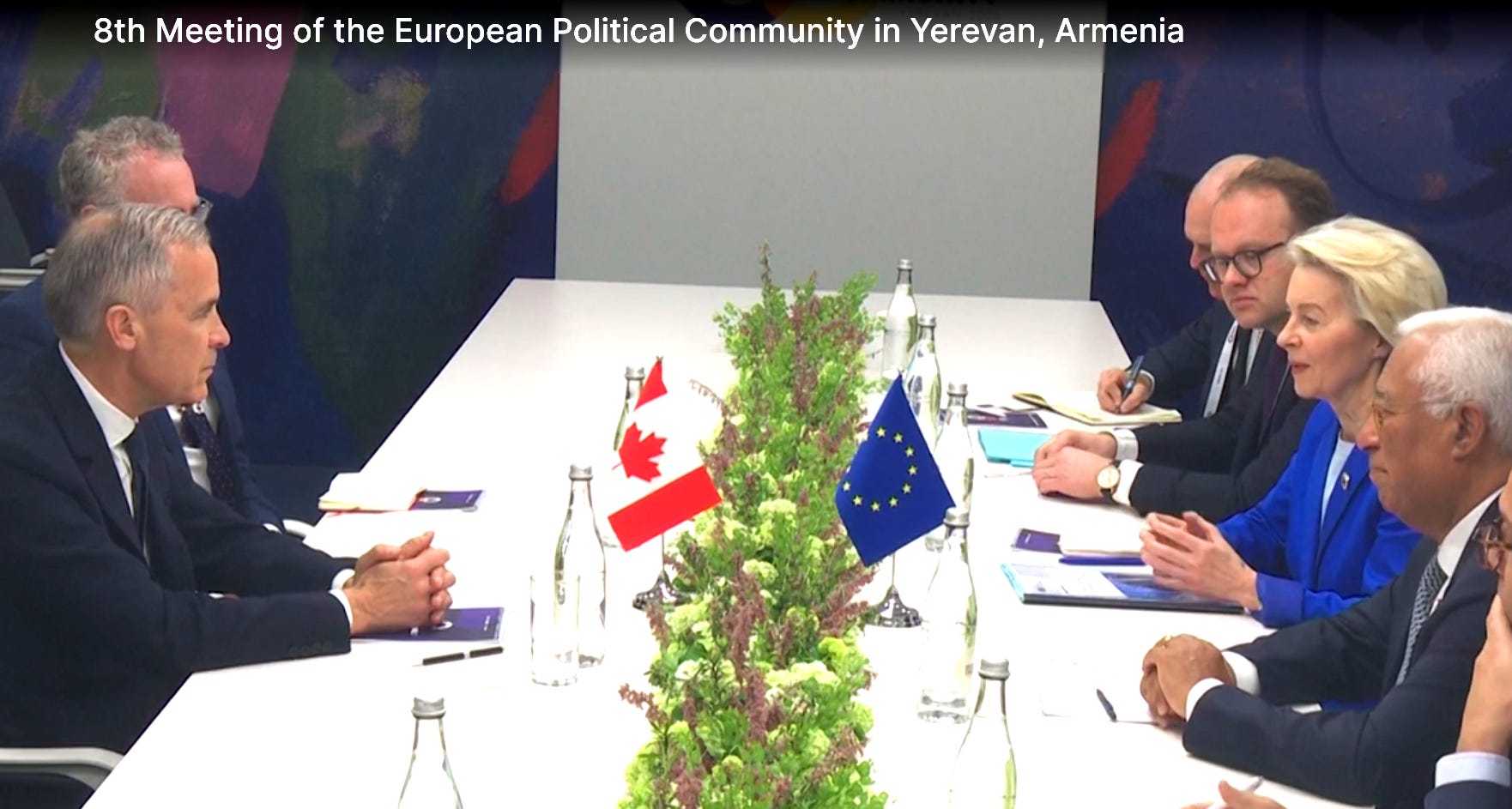
Canada became the first non-European country invited to the EPC
More than 40 heads of state and government took part in this eighth meeting of the European Political Community. Calling for security and multilateralism
The Prime Minister of Canada, Mark Carney, participated in the European Political Community summit as a guest. This is the first time a non-European country has participated in the meeting.
The participation of Canada’s Prime Minister, Mark Carney, in today’s summit is therefore politically very significant. It is a reflection of the strong and growing alignment between Europe and Canada.
Carney made some succinct remarks at the opening meeting. Most importantly—that it is his strong personal view that the international order will be rebuilt, but it will be rebuilt out of Europe.
Now, we have to actively take on the world as it is, not as we wish it to be. We know nostalgia is not a strategy, but we don't think that we're destined to submit to a more transactional, insular, and brutal world. And gatherings such as these point to a better way forward. I think I'll close my remarks with a few observations on strategic autonomy, recognizing that security and prosperity today extend well beyond the traditional areas of food, energy, and defense, important as they are, to include space-based communications, semiconductors, digital sovereignty, critical minerals, independent payment systems, clean energy, and vaccines. And our strategic imperative is to build these sovereign capabilities with the most trusted partners. And that creates enormous opportunities for partnership between Canada and Europe. Uh we view ourselves as highly complimentary to your economic and security goals.
In closing, we’re here because of your invitation. Again, thank you for that. But we’re here because of the moral and security imperatives of our cooperation in the Caucasus, in the Baltics, in Ukraine, across Europe, and also because of the immense potential for our partnerships to build a better, more prosperous, sustainable, and just world for our citizens. And I’ll close with this. Uh it’s my strong personal view that as the international order will be rebuilt, but it will be rebuilt out of Europe. And so I very appreciative of the symbolism of this invitation. Thank you.
Metsola’s direct rebuke
Neighboring Azerbaijan’s President Ilham Aliyev participated with a virtual address to the Summit and took the occasion to launch a direct attack on the European Parliament for spreading what he called ‘slander and lies’ about his country. Aliyev thinks that the Parliament is ‘kind of obsessed’ because it has adopted 14 resolutions critical of Azerbaijan. He also announced that Azerbaijan’s parliament will suspend cooperation with the European Parliament across all areas.
EU Parliament Chair Roberta Metsola then broke protocol and asked for time for a rebuttal:
The European Parliament is a directly elected democratic body with resolutions that are adopted by majority. The outcome might be uncomfortable for some, but we will never change the way we work.
Despite the tense episode, it was still noted as a diplomatic victory that Aliyev had agreed to speak, albeit virtually, at a summit in Armenia, given the history of relentless conflict between the two countries. The most recent peace deal from August 2025 is still not fully implemented, and the road between the countries is still blocked.
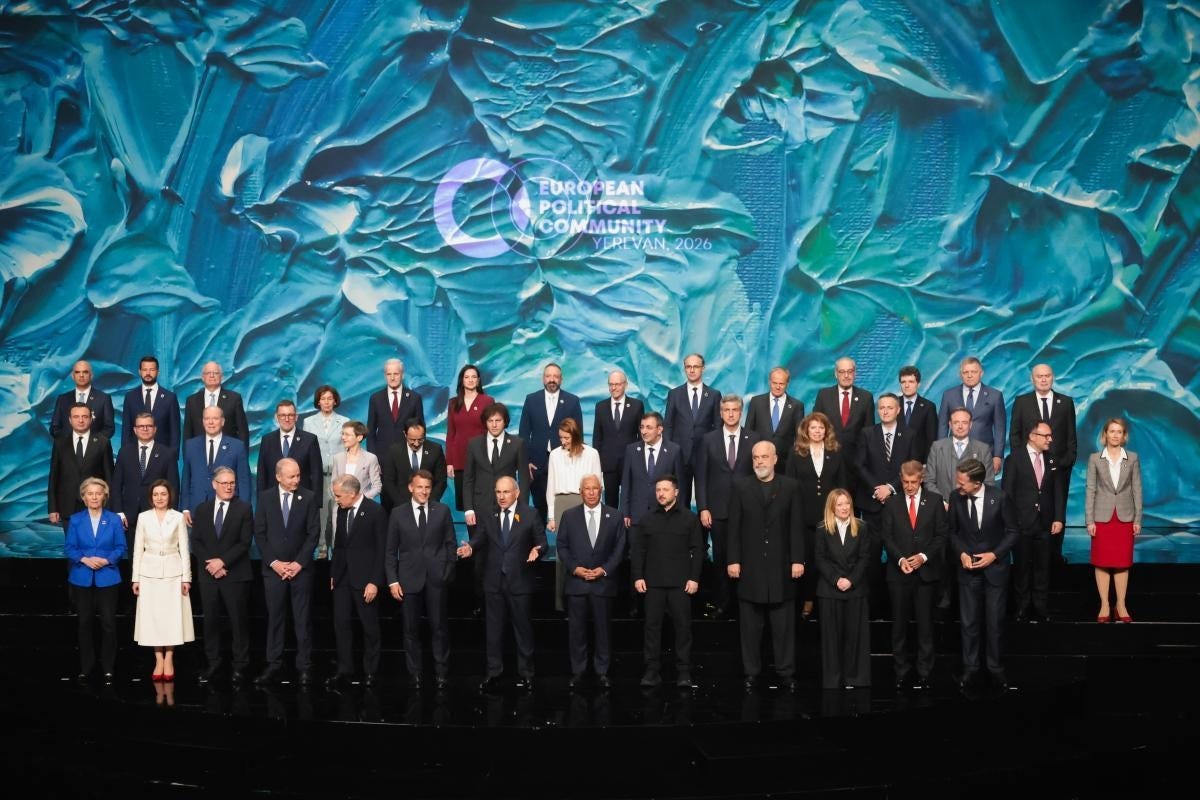
Family photo from the Summit in Yerevan, dated 3 May 2026. Photo: Dati Bendo © CE - Service audiovisuel
António Costa
This story of peace in Europe, in a world where escalation and war seem to dominate, is something to be celebrated. There is a European way of doing things – through multilateralism, with the UN system at its heart, and in respect for international law.
In the current geopolitical context, it is increasingly clear that our continent needs a 360º degree vision for its security. Meeting here, in Armenia, in the South Caucasus, so close to the Middle East – it is a stark reminder that war in Europe’s neighbourhood has a direct impact on our common security, our energy supply and our economy.
That is why, more than ever, the European Union needs to work hand in hand with Armenia and the region for peace and stability. Lasting peace and stability must be anchored in resilient democratic institutions and strong economic bonds between neighbours. That is why today’s EPC summit focussed on the fight against foreign interference in democratic processes, as well as on the power of connectivity to create win-win economic partnerships.
At the same time, we continue to pursue the goal of a just and lasting peace in Ukraine. That is why support for Ukraine continues to be a key focus of the European Political Community. And these were my messages to President Zelenskyy today:
first, the European Union will stand with Ukraine for as long as it takes to achieve a sustainable, just, and lasting peace, in full respect of Ukraine’s territorial integrity;
second, we need to take Ukraine’s accession process forward, by opening the first negotiation cluster as soon as possible.
Any discussion about peace and stability in our continent must include our likeminded partners beyond Europe. The participation of Canada’s Prime Minister, Mark Carney, in today’s summit – the first time, we have invited a non-European guest to an EPC summit – is therefore politically very significant. It is a reflection of the strong and growing alignment between Europe and Canada. And a powerful reminder that a principles- and rules-based international order, with multilateralism and the UN system at its heart, are objectives widely shared around the world.
To conclude, today’s summit, in this region, shows that Europe’s way of doing things – diplomacy, multilateralism, and respect of international law – yields results, it yields peace.
I want to thank, once again, Prime Minister Pashinyan again – for hosting this summit of the European Political Community. And, beyond that, for grasping the historic opportunity to bring Armenia closer to the European Union.
And a final word to the Irish Taoiseach, dear Micheál – to say how much I am looking forward to the next EPC summit in Ireland. I am sure it will be as successful as today’s meeting here in Yerevan.
Thank you.
Thank you for an excellent article on the EPCS. And it’s noteworthy our PM Carney was invited. The importance of dialogue, often charged and difficult, particularly between Armenia and Azerbaijan shows the transparency in European political matters.
I didn't know there IS a European Political Community. With some 48 members or more. Time for me to do some research. Thank you for this article.