
The Truth is Out There
In the US Congress, evidence based discourse has been on retreat since the mid-1970'es, documented by newly published research in Nature Human Behaviour

A new scientific article in the Journal Nature Human Behaviour adds evidence to the belief held by many that the political debate in the United States is no longer driven by facts, but by emotions. The study by researchers from UK, Germany, Israel and Austria is a linguistic study based on computational text analysis of over eight million speeches in the United States Congress from 1879 to 2022. The result is that there is break point in the mid-1970’es where fact-based argumentation peaked and then a strong turn towards emotional or intuition based argumentation. Even if the study does not go beyond 2022, it is safe to say that there are no signs of a return of fact-based argumentation, so far.
The truth may be out there, somewhere, but far away from Congress, at least. Another way to say it is that pathos has won over from ethos and by now the wining party in a debate is whoever has the best story.

Photo by Jelleke Vanooteghem on Unsplash
The research team constructed dictionaries to capture evidence-based and intuition-based language styles that underlie the two conceptions of truth - for example ‘fact’ and ‘proof’ in the evidence-based dictionary and ‘guess’ and ‘believe’ in the intuition-based dictionary. Their final dictionaries consist of 49 keywords for evidence-based language and 35 keywords for intuition-based language.
They then measured the relative salience of evidence-based language over intuition-based language as the evidence-minus-intuition (EMI) score, building on a text analysis approach that has been proven in earlier works by the researchers.
The figure below shows the trend of the EMI score over time, reflecting the relative prevalence of evidence-based language. EMI was high and relatively stable from 1875 through the early part of the twentieth century. Subsequently, an upward trend from the 1940s culminated in a peak in the mid-1970s. Since then, evidence-based language has been on the decline. A positive EMI shows prevalence of fact-based over intuitive arguments. A negative EMI is the opposite, more intuitive than fact-based.
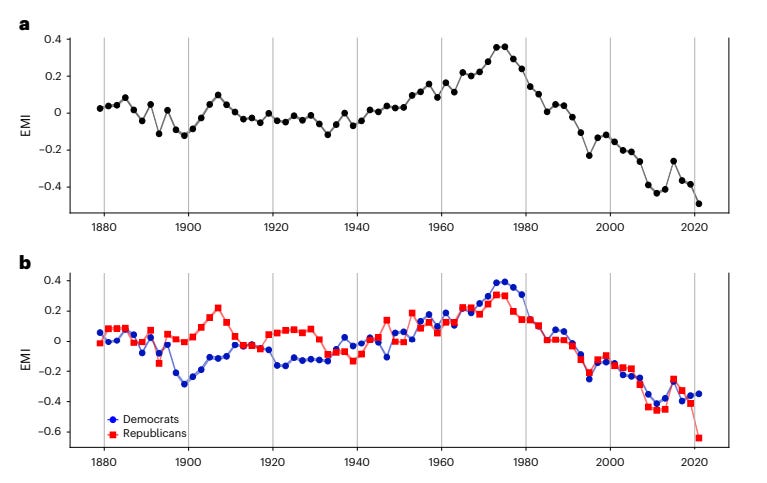
Graphs from the journal article, page 3.
An upward trend from the 1940s culminated in a peak in the mid-1970s. The peak coincides partially with the time when Democrats had a two-thirds majority in Congress and Jimmy Carter was president. After that, EMI was in rapid decline to hit an all time low with the 2021-22 Congress, the latest analyzed by the researchers. The Congress with the most emotional rhetoric in the 144 years that the study covers. It also shows a split between the parties with Republicans currently diving much deeper into non-factual rhetoric than Democrats.
Honesty is not a winning concept
Fabio Carrella and co-authors of the study say in the abstract of an earlier article that ‘politicians’ conception of honesty has undergone a distinct shift, with authentic belief speaking that may be decoupled from evidence becoming more prominent and more differentiated from explicitly evidence-based fact speaking.’ In other words, politicians lie and evidence doesn’t matter any more, as long as you have a good story.
Pursuit of honest and truthful decision-making is crucial for governance and accountability in democracies. However, people sometimes take different perspectives of what it means to be honest and how to pursue truthfulness. Here we explore a continuum of perspectives from evidence-based reasoning, rooted in ascertainable facts and data, at one end, to intuitive decisions that are driven by feelings and subjective interpretations, at the other. We analyze the linguistic traces of those contrasting perspectives in congressional speeches from 1879 to 2022. We find that evidence-based language has continued to decline since the mid-1970s, together with a decline in legislative productivity. The decline was accompanied by increasing partisan polarization in Congress and rising income inequality in society. The results highlight the importance of evidence-based language in political decision-making.
Other findings
The study also finds a correlation with polarization in public debate, that EMI drops in times of polarization, not surprisingly. A drop in EMI also seem to precede a trend of higher income inequality.
Finally, the researchers are able to show that a low EMI means a less productive Congress, using different measures of amount and importance of legislation passed.
From a completely commonsense point of view, history and factual analysis is showing us that politics based on storytelling with no factual basis is what led us to the perilous situation of today.